Shabads
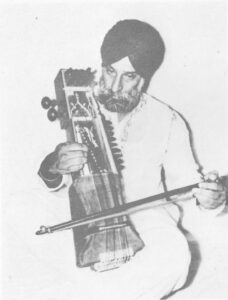
Biography
Bhai Seva Singh Gandharab was born in Singapore in 1920 and became one of the early Sikh community’s most respected Kirtanis. Gifted with a deep musical sensibility from a young age, he excelled in traditional Gurbani Kirtan and was especially known for his command of Raags and Taals. His musical journey began early, learning basic ‘Sargams’ from his elder brother at around the age of eight. Recognising his passion, his father purchased him a harmonium for a modest sum, setting the foundation for a lifelong dedication to music.
In his youth, Bhai Seva Singh accompanied local jathas in the Gurdwara, initially on the ‘Dholki’, before transitioning to the harmonium. By the age of eighteen, he had begun to immerse himself in classical music. Around 1939, he furthered his training by learning ‘Tabla’ under the renowned ‘Pakhawaj’ player Krishandev Tiwari, who was based in Singapore at the time.
He was also deeply influenced by the vibrant musical culture of the era, regularly attending mehfils held at the Dargah along Serangoon Road and Racecourse Road. These gatherings featured distinguished artists such as Master Saavan, Veer Chand, Ustad Noor Khan, Ustad Mohamad, and Dr. Chhota Singh. Immersing himself in these performances, Bhai Seva Singh absorbed diverse styles and traditions, further enriching his artistry. Recognizing his dedication and potential, Master Bhag Singh took him under his wing as a shagird (student), imparting to him the rigorous training he himself had received from Ustad Jeevan Khan of the Patiala Gharana.
During the Japanese occupation, Bhai Seva Singh joined the jatha of Master Bhag Singh. This group was among the first locally born Sikh youth jathas in Singapore and was comparable to many established jathas in India. Under this guidance, he developed a strong grounding in both classical and devotional music, and his family also became actively involved in performing Kirtan.
Though he gained extensive knowledge from his teachers, Bhai Seva Singh remained a lifelong learner. After World War II, he travelled widely across India and Pakistan, seeking konwledge from esteemed musicians and expanding his understanding of classical forms. His compositions suggest influences from prominent figures such as Giani Gian Singh Ji Almast, and he also referenced Baba Jwala Singh of Tatha Tibba in his work, indicating either direct or indirect learning from these traditions.
Alongside his musical pursuits, Bhai Seva Singh served the wider community through his work as a hospital assistant at Tan Tock Seng Hospital, embodying a life of both sewa (service) and artistry. His contributions to Sikh heritage were formally acknowledged when he was awarded a ‘Siropa’ at Sri Harmandir Sahib in Amritsar, as well as a shield by the Indian Chamber of Commerce in Singapore.
A scholar as well as a performer, he authored two significant works. His book ‘Gurbani Sangeet’ documents the theory of many rare Raags, including those found in the Guru Granth Sahib Ji and in Hindustani classical music. To complement this work, he recorded four cassettes featuring compositions for each Raag discussed. He also preserved the history of his community through his book ‘Early Sikh Pioneers of Singapore’, an important record of the first Sikh settlers in the region.
Music remained a central thread in his family life as well. His eldest son, Terlochan Singh, became an accomplished sitarist trained under Ustad Wilayat Khan, as well as a classical vocalist who earned recognition in competitions across Singapore. His other sons, Satwant Singh and Surinderjeet Singh, were also skilled tabla players. His youngest son, Prithipal Singh, remains based between Singapore and Melbourne, continuing the family’s connection to its cultural roots.
Bhai Seva Singh’s Kirtan left a lasting impression on all who heard him. One particularly memorable moment occurred during the Malaya Diwan Samagam at GNI Ipoh around April 1978. Upon taking the stage, he noticed Giani Jagdish Singh Ji, a senior student of Prof. Darshan Singh Komal, seated among the Sangat. Inviting him to accompany on ‘Tabla’, the two delivered a remarkable performance in ‘Chartaal’. Midway through the Shabad, Bhai Seva Singh humorously remarked that they were like “male goats fighting with each other,” capturing both the intensity and joy of their musical exchange. It was a moment that reflected not only technical mastery, but also the spirit of camaraderie and devotion that defined his lifelong dedication to the art of Kirtan.
Recordings
126 tracks
Recordings contributed by Sardar Harbhajan Singh Gill
Recordings contributed by Sardar Harbhajan Singh Gill
Tape 1 – Raags of SGGS (Theory & Practical)
The Shabads below are from a set of cassettes recorded in Singapore. These were also contributed by Sardar Harbhajan Singh Gill. Tape 1 – Raags of SGGS (Theory & Practical)
Tape 1 – Raags of SGGS (Theory & Practical)
The Shabads below are from a set of cassettes recorded in Singapore. These were also contributed by Sardar Harbhajan Singh Gill. Tape 1 – Raags of SGGS (Theory & Practical)
Tape 2 – North Indian Raags part 1
From cassettes recorded in Singapore and contributed by Sardar Harbhajan Singh Gill.
Tape 2 – North Indian Raags part 1
From cassettes recorded in Singapore and contributed by Sardar Harbhajan Singh Gill.
Tape 3 – North Indian Raags part 2
From cassettes recorded in Singapore and contributed by Sardar Harbhajan Singh Gill.
Tape 3 – North Indian Raags part 2
From cassettes recorded in Singapore and contributed by Sardar Harbhajan Singh Gill.
Tape 4 – Dharmak Kavtas
From cassettes recorded in Singapore and contributed by Sardar Harbhajan Singh Gill.
Tape 4 – Dharmak Kavtas
From cassettes recorded in Singapore and contributed by Sardar Harbhajan Singh Gill.
Recordings contributed by Bhai Seva Singh Ji’s youngest son, S
The following recordings were kindly contributed by Bhai Seva Singh Ji’s youngest son, S. Prithpal Singh ji.
Recordings contributed by Bhai Seva Singh Ji’s youngest son, S
The following recordings were kindly contributed by Bhai Seva Singh Ji’s youngest son, S. Prithpal Singh ji.
The following recordings were obtained from ‘Sikhnet’.
The following recordings were obtained from ‘Sikhnet’.
Page comments
No page comments yet.
Comments 0
No comments on this recording yet.
No comments on this recording yet.
No comments on this recording yet.
No comments on this recording yet.
No comments on this recording yet.
No comments on this recording yet.
No comments on this recording yet.
No comments on this recording yet.
No comments on this recording yet.
No comments on this recording yet.
No comments on this recording yet.
No comments on this recording yet.
No comments on this recording yet.
No comments on this recording yet.
No comments on this recording yet.
No comments on this recording yet.
No comments on this recording yet.
No comments on this recording yet.
No comments on this recording yet.
No comments on this recording yet.
No comments on this recording yet.
No comments on this recording yet.
No comments on this recording yet.
No comments on this recording yet.
No comments on this recording yet.
No comments on this recording yet.
No comments on this recording yet.
No comments on this recording yet.
No comments on this recording yet.
No comments on this recording yet.
No comments on this recording yet.
No comments on this recording yet.
No comments on this recording yet.
No comments on this recording yet.
No comments on this recording yet.
No comments on this recording yet.
No comments on this recording yet.
No comments on this recording yet.
No comments on this recording yet.
No comments on this recording yet.
No comments on this recording yet.
No comments on this recording yet.
No comments on this recording yet.
No comments on this recording yet.
No comments on this recording yet.
No comments on this recording yet.
No comments on this recording yet.
No comments on this recording yet.
No comments on this recording yet.
No comments on this recording yet.
No comments on this recording yet.
No comments on this recording yet.
No comments on this recording yet.
No comments on this recording yet.
No comments on this recording yet.
No comments on this recording yet.
No comments on this recording yet.
No comments on this recording yet.
No comments on this recording yet.
No comments on this recording yet.
No comments on this recording yet.
No comments on this recording yet.
No comments on this recording yet.
No comments on this recording yet.
No comments on this recording yet.
No comments on this recording yet.
No comments on this recording yet.
No comments on this recording yet.
No comments on this recording yet.
No comments on this recording yet.
No comments on this recording yet.
No comments on this recording yet.
No comments on this recording yet.
No comments on this recording yet.
No comments on this recording yet.
No comments on this recording yet.
No comments on this recording yet.
No comments on this recording yet.
No comments on this recording yet.
No comments on this recording yet.
No comments on this recording yet.
No comments on this recording yet.
No comments on this recording yet.
No comments on this recording yet.
No comments on this recording yet.
No comments on this recording yet.
No comments on this recording yet.
No comments on this recording yet.
No comments on this recording yet.
No comments on this recording yet.
No comments on this recording yet.
No comments on this recording yet.
No comments on this recording yet.
No comments on this recording yet.
No comments on this recording yet.
No comments on this recording yet.
No comments on this recording yet.
No comments on this recording yet.
No comments on this recording yet.
No comments on this recording yet.
No comments on this recording yet.
No comments on this recording yet.
No comments on this recording yet.
No comments on this recording yet.
No comments on this recording yet.
No comments on this recording yet.
No comments on this recording yet.
No comments on this recording yet.
No comments on this recording yet.
No comments on this recording yet.
No comments on this recording yet.
No comments on this recording yet.
No comments on this recording yet.
No comments on this recording yet.
No comments on this recording yet.
No comments on this recording yet.
No comments on this recording yet.
No comments on this recording yet.
No comments on this recording yet.
No comments on this recording yet.
No comments on this recording yet.
No comments on this recording yet.
No comments on this recording yet.
No comments on this recording yet.
No comments on this recording yet.
No comments on this recording yet.